

What to Wear to a Parsi Wedding
THE WEDDING GUIDE
What to wear to a Parsi wedding
Someone messaged us this week to ask whether we could help with a Parsi wedding in India.
LOVELEEN SARI PALACE · ARTESIA · SINCE 1990


It is a good question, and the honest answer is that it deserves a proper explanation rather than a one-line reply. So here it is.
Explore outfit options
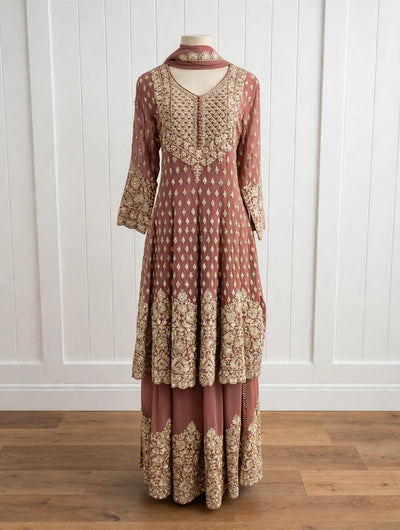
Browse a few looks for color, silhouette and styling ideas. What is in store changes often, so visit us to see current options.


Swipe or use the arrows to browse. Photos show outfit ideas; available sizes and colors vary.
The headline: at a Parsi wedding, white is right. If you have read anything else on this site, you will have seen us say to skip white, because in many Indian traditions it is a mourning color. A Parsi wedding is the exception, and it is not a small one. The bride wears white. The groom wears white. Guests in ivory and soft pastels look exactly as they should.
If you follow the usual Indian-wedding advice here, you will get it wrong.
What a Parsi wedding is
Parsis are Zoroastrians whose ancestors came to India from Persia over a thousand years ago, settling mostly in Gujarat and later Mumbai. It is a very small community — a few tens of thousands of people in India — so being invited to a Parsi wedding is a genuinely lovely thing. Most people go to one in their life, if that.
The main ceremony is called the Lagan. You will also hear the wedding as a whole called that. It is shorter and quieter than a Punjabi or Gujarati wedding, and the mood is elegant rather than loud. There is no baraat, no horse, no dancing procession. That surprises people who have only been to North Indian weddings.
The color rule, reversed
White at a Parsi wedding is celebratory. It reads as purity and light, which sits at the heart of Zoroastrian thinking, and it is what the couple themselves wear.
So for the Lagan:
- White, ivory, cream and oyster are all correct. You will not be mistaken for the bride — she will be unmissable, and everyone knows who she is.
- Soft pastels are the sweet spot for guests. Blush, powder blue, sage, pale gold, dove grey. This is where most guests land and it always looks right.
- The room will not be uniformly pale, and it helps to expect that. Many of the Parsi women present will be wearing their gara, and garas are frequently deep — purple and violet above all, along with wine, navy and black. Those are entirely correct. Pale is the easy choice for a guest, not the only permitted one.
- Plain black is the one to think twice about. Not forbidden — black is a common ground for a gara, and a black gara is a beautiful thing. But a plain black outfit with no work on it can read severe in a room like this. If black is your instinct, pick one with some embroidery.
- You can go brighter at the reception. The white convention belongs to the ceremony. Later in the evening, color is fine.
That is genuinely the whole rule. It is simpler than most Indian weddings, not harder.
What the couple will be wearing
Worth knowing, so you can pitch yourself correctly rather than guessing.
The bride wears a white sari, usually silk or georgette, embroidered in what is called a gara. More on that below, because it is the most interesting thing in Parsi dress and the thing people ask about most.
The groom wears a dagli — a white coat, long and slightly flared, over a white kurta and white trousers. On his head is a feta or pagdi, a stiff black hat. The whole effect is closer to formal Edwardian dress than to a sherwani, and it is one of the most distinctive looks in Indian menswear.
About gara — the honest version
Gara embroidery is the Parsi signature. It came back with Parsi traders working with China in the nineteenth century, and it looks like it: cranes and roosters, peonies and lotuses, little figures on bridges, all worked in fine satin stitch on silk. A real gara is embroidered over months.
Here is the part other shops will not tell you plainly: a true gara is usually an heirloom, not a purchase. They are handed down. Families keep them, repair them, and lend them to daughters and nieces. Genuine antique ones are collector pieces and priced like it.
We do not sell garas. We would rather say that than sell you something approximate and call it one. What we can do is put you in a white, ivory or pastel sari that sits correctly in that room, which is what a guest actually needs.
What to wear if you are a guest — women
A sari is the safest and most appropriate choice, and it does not have to be complicated.
- A white or ivory sari with fine silver or tonal work. Understated beats heavy here — Parsi dressing is not a maximalist tradition.
- A pastel sari in blush, sage, powder blue or pale gold. This is what most guests wear and it is never wrong.
- A pre-draped sari if you have never worn one. It is stitched into shape and goes on like a dress, so there is no pinning and nobody has to help you at 6am.
- A salwar kameez or anarkali in the same palette is perfectly acceptable, particularly if a sari feels like too much for a first time.
Cover your shoulders for the ceremony. Bring something for your head — more on that shortly.

What to wear if you are a guest — men
This is easier than most men expect, and the answer is probably already close to what you own.
- A white or cream kurta pajama is a straightforward choice. A Nehru jacket or vest is optional if you want an extra layer; follow the hosts’ guidance for the ceremony.
- A cream or pastel kurta pajama on its own works too.
- A well-cut suit is genuinely fine at a Parsi wedding, more so than at most Indian weddings. Light grey, stone or navy. This is a community that has worn Western tailoring for generations.
- Do not wear a feta. The black hat belongs to the groom and to Parsi men. A guest in one looks like they are in costume.

Men's kurta pajamas are $75 to $125 with us, Nehru jackets and vests from $100. A white kurta with an ivory jacket is about as safe as this gets — the pair above is close to the ideal.
What actually happens
So you are not lost when it starts.
- Achu Michu — the couple are welcomed with a tray of rice, coconut, dates and betel nut, circled around them to turn away anything unlucky. Water is thrown to one side. It is quick and warm and you may miss it if you are talking.
- Ara Antar — the bride and groom sit facing each other with a white cloth held up between them so they cannot see one another. Rice is placed in their hands. When the cloth drops, whoever showers the other with rice first is said to win. It is the funniest part of the day and everyone cheers.
- The Lagan itself — two priests, called dasturji, recite blessings for the better part of an hour while rice and rose petals are showered over the couple. Rings are exchanged at the end.
You do not need to do anything except sit, watch, and join in the rice at the right moment. If in doubt, follow the person next to you.
Practical things worth knowing
- The timing will look odd. Parsi weddings are often held at very specific hours — a great many begin around 6:40 in the evening, and some are held very early in the morning. Both are considered auspicious. Take the invitation time literally.
- Ask where the ceremony is. Some Lagans take place at an agiary, a Zoroastrian fire temple, and non-Parsis are generally not permitted inside one in India. For this reason many weddings are held instead in a baug — a garden or hall — where everyone is welcome. It is a completely normal thing to ask the couple, and much better than finding out on the day.
- Heads are often covered during the religious part, by men and women both. A dupatta or a scarf handles it. Bring one even if you end up not needing it.
- You will take your shoes off at some point. Wear something you can slip out of.
- Eat. Parsi wedding food has a reputation and it has earned it — patra ni machhi steamed in banana leaf, sali boti, and lagan nu custard, which exists more or less only for weddings. Traditionally it is served on a banana leaf. Go hungry.
What it costs
A complete guest outfit with us usually lands between $150 and $250. White, ivory and pastel saris start at $150; salwar kameez from $100; men's kurta pajamas $75 to $125 with jackets and vests from $100.
Come in and we will sort it
Bring the invitation, or just tell us it is a Parsi wedding and roughly what time of day. We will pull whites, ivories and pastels and you will be out of the door in about twenty minutes. We are at 18507 Pioneer Boulevard, Artesia, in Little India. Free parking behind the store, open Tuesday through Sunday until 6:45 PM, closed Mondays, no appointment needed.
Or message us on Instagram at @loveleensari first and send a photo of the invitation. A person answers, usually the same day.
Read next
- Going to your first Indian wedding — the events in order, and what happens at each
- Can I wear Indian clothes as a non-Indian guest? — the short answer is yes
- The men's guide — kurta, jacket, sherwani or a good suit
- FAQ — hours, parking, sizing and what we carry
Come try it on in Artesia
Everything here is on the rack at 18507 Pioneer Blvd. Walk in any day except Monday — or book a time and we will have options pulled and waiting for you.
Book a visitCome try on the outfits
See the colours, feel the fit, and try a few styles in our Artesia fitting rooms. We’ll help you find an outfit that feels right for you and your event. Walk-ins welcome.