

Indian Wedding Guest Checklist for First Timers
THE WEDDING GUIDE
Your first Indian wedding checklist
Going to your first Indian wedding?
LOVELEEN SARI PALACE · ARTESIA · SINCE 1990


Start thinking about what you are wearing earlier than you would for a wedding you already understand.
Explore outfit options
Browse a few looks for color, silhouette and styling ideas. What is in store changes often, so visit us to see current options.
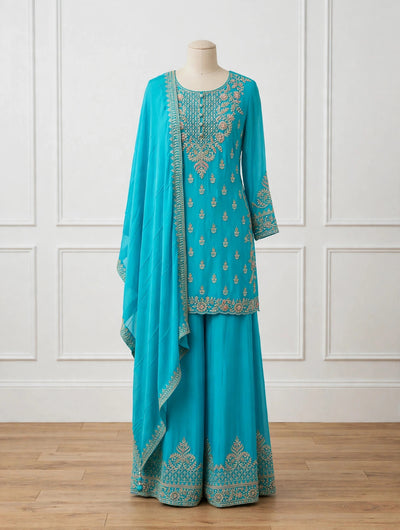


Swipe or use the arrows to browse. Photos show outfit ideas; available sizes and colors vary.
Not because it is difficult, but because there is usually more than one event. A weekend might include a mehndi, a sangeet, a religious ceremony and a reception, and what works on Friday night can be wrong for Saturday morning. You almost certainly do not need four new outfits. You do need to know what you are attending before you decide what to wear to any of it.
This is the planning list. If you want to know what actually happens at each event — the baraat, the timings, the food, the shoes — that is our guide to going to your first Indian wedding. This page is about the decisions you make before you shop.
1. Read the invitation before you look at a single outfit
The invitation is the brief. It tells you how many events there are, what each one is called, where they are and, often, what to wear — though not always in words you will recognise.
Work out:
- How many events you are actually invited to
- Which one is the most formal
- Whether there is a religious ceremony, and which tradition
- Indoor or outdoor
- Daytime or evening
- Any dress code, in whatever wording they used
"Indian festive." "Traditional attire." "Cocktail with an Indian twist." These phrases mean real things, and they mean different things at different events.
If an invitation says Indian festive, see what that means in practice before you decide on an outfit.
This is the part where we can save you the most time. Bring the invitation in and we will read it with you. We do it several times a week, and it takes about two minutes to turn four unfamiliar event names into a plan for the weekend.

What if the invitation says pastels?
A pastel dress code usually means soft, light colors such as blush pink, powder blue, mint, lavender or peach. It describes the color palette, not one particular garment: a sari, lehenga, sharara or anarkali can fit the theme. Keep any instructions about formality and ceremony coverage in mind, and follow a specific palette if the couple provides one.
You do not need to know the outfit names before you shop. If you have the invitation or a color reference, show us and we will help you find an outfit that suits the theme and feels like you. See pastel Indian wedding guest outfits in our lookbook.
2. Plan the weekend as a set, not one event at a time
The common mistake is shopping for Saturday, loving something, buying it, and then discovering there are two more events with different requirements.
Decide which event you want to dress up hardest for — usually the sangeet or the reception — and let the others sit a level below. Something you already own may be perfectly good for a daytime event. An outfit can often be restyled and worn twice across a weekend, particularly if the two events are on different days and different sides of the family.
Two assumptions worth dropping before you start:
- Women do not automatically need a lehenga. A sari, an anarkali, a gown, a sharara or a salwar suit may suit the event and suit you better. There are six silhouettes here and they are not interchangeable.
- Men do not automatically need a sherwani. A kurta pajama is a complete outfit for many wedding events. A vest or Nehru jacket is optional if you want a dressier layer; a good suit is another reception option. Follow the invitation’s level of formality. The men's guide has the full ladder.
If you already know a sari is not for you, start with Indian wedding outfit options beyond a sari.
Do I need a different outfit for every event?
No. Wearing the same outfit to events on the same day is usually completely fine, as long as it suits both events and their dress codes. You do not need a second look just to change between them.
If you would like a change, it can be as simple as swapping the blouse or dupatta, or wearing different jewelry; those are styling options, not extra things you need to buy. A change can make sense when the settings genuinely differ — for example, a religious ceremony followed by a formal reception — or when you want something more comfortable after dancing.
3. Find out what kind of ceremony it is
This one changes the garment, not just the colour.
Depending on the tradition and the venue, you may be taking your shoes off, covering your head, sitting on the floor for an hour, or wanting more coverage across the shoulders than you had planned. None of that is difficult — but it is much easier to know before you buy than after.
Worth checking:
- Do shoes come off at the venue?
- Is a head covering expected? (At a Sikh ceremony, yes, for everyone.)
- Is more shoulder or leg coverage appropriate?
- Could you be sitting on the floor?
- How long does the ceremony run?
We have guides to what guests wear at Hindu, Sikh, Muslim and Parsi weddings, because the answers genuinely differ. If you are not sure which one you are going to, the invitation will usually tell us.
4. Try it on the way you will actually wear it
Indian weddings are long. An outfit that looks excellent standing still in front of a mirror also has to survive six hours of sitting, eating, queueing and dancing.
In the fitting room:
- Sit down in it, properly, the way you will at dinner
- Walk the length of the store
- Raise your arms above your head — everything should stay where it was
- Check you can manage a bathroom in it without assistance
- If there is a sangeet, move like you intend to dance, because you will
You do not need to know any Indian dances in advance. You will still end up on the floor at the sangeet — everyone does — so the outfit needs to allow for it.

5. Sort the shoes out early, because they change the hem
This surprises people. Lehengas, saris and gowns are worn long, and the heel height you choose changes where the hem sits. Two inches of heel is the difference between a hem that skims the floor and one you tread on all night.
So decide the shoes at the same time as the outfit, not the week after. Think about how much you will be walking and dancing, whether the event is on grass, and whether they are coming off at the ceremony anyway — which affects what you want on your feet underneath.
Already have the shoes? Bring them with you. We would much rather check the length against the real thing.
6. Going as a couple? Coordinate, do not match
You want to look like you arrived together without looking like a set. One shared detail usually does it — an accent colour, gold on both, similar embroidery, or simply the same level of formality — and it beats hunting for two outfits in an identical shade.
If one of you already has an outfit, bring the actual garment rather than a photograph of it, and we can build the second look around it. There is more on coordinating as a couple here.
7. Do not leave this to the wedding week
Indian clothing is hard to order online when you have never worn any before. Sizing does not map onto what you are used to, colours photograph differently to how they look in daylight, and the terminology on the product page assumes you already know what you are buying.
We see the results every month. The parcel that did not arrive. The one that arrived on the Thursday for a Saturday wedding. The one that arrived on time and turned out to be a completely different weight of fabric than it looked on screen. In each case somebody is starting over with two days to go.
We can nearly always sort it out — that is what the last-minute page is for — but it is a better weekend if you never need that page at all.
8. Shop where you can ask the obvious questions out loud
What is the difference between a lehenga and a sharara? Is this too dressy for the mehndi? Is it dressy enough for the reception? Which way does the dupatta go, and does it stay there once I start dancing?
Those are exactly the right questions, and they are much easier to answer with the garment in front of you than in a chat window. You do not need to turn up knowing Indian sizing or the name of anything. That is our job.

9. The night before, put the whole thing on
All of it, together: outfit, shoes, dupatta, jewellery, underthings, the lot.
Sit down in it again. Check the length with the shoes you are actually wearing. Make sure you know how each piece attaches, in what order, and where the pins go. Then steam or press whatever needs it and hang the complete look somewhere you can get at it.
The morning of the wedding is a poor time to discover that the dupatta has a right way round, or that your heels change the hem by two inches.
Still working out what to wear?
Bring your wedding invitation to Loveleen Sari Palace in Artesia. We will look at the events you are going to, the venue and whatever the dress code says, and work out what you need for the weekend — then start pulling things off the rail.
We are at 18507 Pioneer Boulevard, in the middle of Little India, with free parking in our own lot behind the store. Walk-ins are welcome and no appointment is needed. Wear something easy to change in and out of, and bring the shoes if you have them.
We have been dressing people for Indian weddings since 1990, and first-time guests are a large part of what we do. Yes, there is a fair amount to work out. We do it every day. Bring us the invite and we will work it out with you. Questions first? We are on Instagram at @loveleensari.
Read next
- Going to your first Indian wedding — what actually happens, event by event
- Can I wear Indian clothes as a non-Indian guest? — the short answer is yes
- Coordinating as a couple — how to match without matching
- Gifting at an Indian wedding — how much, and why it ends in a one
- Am I too late to buy Indian clothes? — if the wedding is this week
- Going while pregnant? — the silhouettes that work, and when to shop
Come try it on in Artesia
Everything here is on the rack at 18507 Pioneer Blvd. Walk in any day except Monday — or book a time and we will have options pulled and waiting for you.
Book a visitCome try on the outfits
See the colours, feel the fit, and try a few styles in our Artesia fitting rooms. We’ll help you find an outfit that feels right for you and your event. Walk-ins welcome.